





CMA Submits Recommendations for the 2026-27 Budget
The Chinese Manufacturers’ Association of Hong Kong (the CMA) has submitted its proposal for the 2026-27 Budget to the Hong Kong SAR Government, outlining over 90 recommendations across key areas. These include boosting domestic demand, supporting SMEs, promoting innovation and technology (I&T) and new industrialisation, accelerating the development of the Northern Metropolis, and strengthening cross-boundary cooperation.
During a media briefing today (26 January), Dr Wingco Lo, President of the CMA, stated that while Hong Kong’s economy achieved steady recovery in 2025, the global outlook remains uncertain, with geopolitical risks potentially escalating. According to the association’s latest member survey, businesses generally maintain a cautious outlook for 2026. With export growth anticipated to moderate, domestic demand is expected to become the main driver of economic growth. Dr Lo calls on the government to take a more proactive role in boosting local consumption to sustain Hong Kong’s economic resilience.
Boosting domestic demand and fostering collaborative industrial growth
The CMA suggests that the government continue to roll out one-off relief measures and consider introducing incentives such as lucky draws to encourage local spending. The association also recommends favourable policies to create more diverse spending opportunities, including fostering the pet economy, rural homestays economy and hawker economy.
To support SMEs, the CMA calls for extending the application period of the 90% Guarantee Product under the SME Financing Guarantee Scheme to March 2028, in line with the 80% Guarantee Product. It also urges the government to review and improve the principal moratorium arrangement as needed.
In promoting I&T and new industrialisation, the CMA emphasises the importance of collaboration among government, industry, academia, research, and investment. It calls for enhancements to the Innovation and Technology Fund, enabling more independent applications by enterprises and incorporating economic indicators such as commercialisation potential, intellectual property value, and market prospects into the funding assessments. It also proposes further enhancing the mechanism of the Innovation and Technology Support Programme by exploring the introduction of a fast-track sub-programme specifically designed for collaborative projects that facilitate technology transfer and drive business upgrading.
To accelerate the translation of R&D into market-ready solutions, the CMA proposes the establishment of a technology and economic trading platform and service alliance led by universities and supported by strong industry participation.
In line with the global industrial shifts, the CMA advocates adopting a Gross National Income (GNI)-oriented approach to economic development, formally recognising outward industrial activities as part of Hong Kong’s manufacturing and new industrialisation ecosystem. To this end, the government should conduct a comprehensive survey of Hong Kong-funded manufacturing enterprises operating outside the city and develop a set of statistical indicators to track their development. The government should also set up a dedicated task force to better support this sector.
The CMA also reinforces the importance of supporting the high-quality development of “Specialised, Refined, Distinctive and Innovative” (SRDI) enterprises. It recommends the establishment of a Hong Kong-specific evaluation framework and recognition mechanism for SRDI enterprises, supported by tailored support policies. To provide a solid evidence base for policy formulation, the CMA has commissioned the HKUST Li & Fung Supply Chain Institute to carry out a dedicated study on this topic.
Accelerating the development of the Northern Metropolis
Regarding the future development of the Northern Metropolis, the CMA believes it is necessary to clearly define the functional positioning and collaborative relationships among various key zones, such as San Tin Technopole, the Loop, and Sha Ling, to avoid duplication and resource waste. The CMA also suggests partnering with renowned international or Mainland industrial park developers as strategic partners to accelerate development.
The CMA sees potential in expanding convention and exhibition facilities in the Northern Metropolis, aligned with the area’s industrial focus. It suggests prioritising expos in I&T, higher education, and emerging sectors such as new energy vehicles and low-altitude economy. In addition, integrating animation, film, cultural and creative industries, and eco-tourism could help create a demonstration zone for cultural-tourism integration.
Driving diversified economic growth
To strengthen Hong Kong’s position as a commodity trading hub, the CMA recommends introducing more spot and futures trading platforms for commodities such as coffee, soybeans, and non-ferrous metals. It also proposes utilising bonded warehouses in Mainland GBA cities to facilitate cross-border warehousing and delivery, and leveraging Hong Kong’s free port and logistics advantages to attract high-value, regulated goods for offshore storage and settlement.
The CMA welcomes the signing of a cooperation agreement between the Financial Services and the Treasury Bureau and the Shanghai Gold Exchange. To further enhance regional financial integration, the CMA recommends deepening collaboration with Mainland commodity exchanges to facilitate the cross-boundary listing of related financial products. At the same time, efforts should be made to develop RMB-denominated commodity benchmarks and settlement mechanisms. These initiatives would help mitigate exchange rate and price volatility, while contributing to the broader goal of RMB internationalisation.
In response to growing efforts by both Hong Kong and Mainland enterprises to expand into international markets, the CMA proposes establishing Hong Kong as a preferred platform for brands going global. It recommends fostering strategic alliances between local and national brands to leverage Hong Kong’s strengths and services. To support this vision, the CMA has consolidated its resources and will soon launch a one‑stop service to facilitate enterprises’ global expansion.
To inject new momentum into economic diversification, the CMA has also proposed initiatives such as promoting the silver economy, developing industrial tourism, expanding the halal market, establishing a regional intellectual property trading centre, and supporting enterprises in expanding into the Mainland domestic market.
As the country enters the 15th Five-Year Plan period, the CMA advocates for deeper cooperation between the government and the business sector to ensure close alignment with the latest national strategies. This collaboration should focus on formulating concrete, measurable action plans to advance Hong Kong as the “Eight Centres + Talent Hub”, while identifying new roles that leverage the city’s unique strengths.
Specifically, the CMA proposes positioning Hong Kong as an “International Brand Hub”, a “Going Global Launchpad”, and a “High-Value-Added International Supply Chain Management Centre”. It also encourages the government to seek formal recognition of these roles within the national development agenda. Such efforts will enable Hong Kong to more effectively contribute to and respond to the evolving needs of national development.
Other office-bearers of the CMA attending the media briefing included Dr Warren Ma, Executive Vice President; Professor Simon Wong, Mr Dennis Ng Kwok On, Mr Calvin Chan, The Hon Albert Chuang, and Dr Ellis Wong; Vice Presidents; and Ms Ida Ng, Chief Executive Officer.
Encls:
Summary of CMA budget recommendations
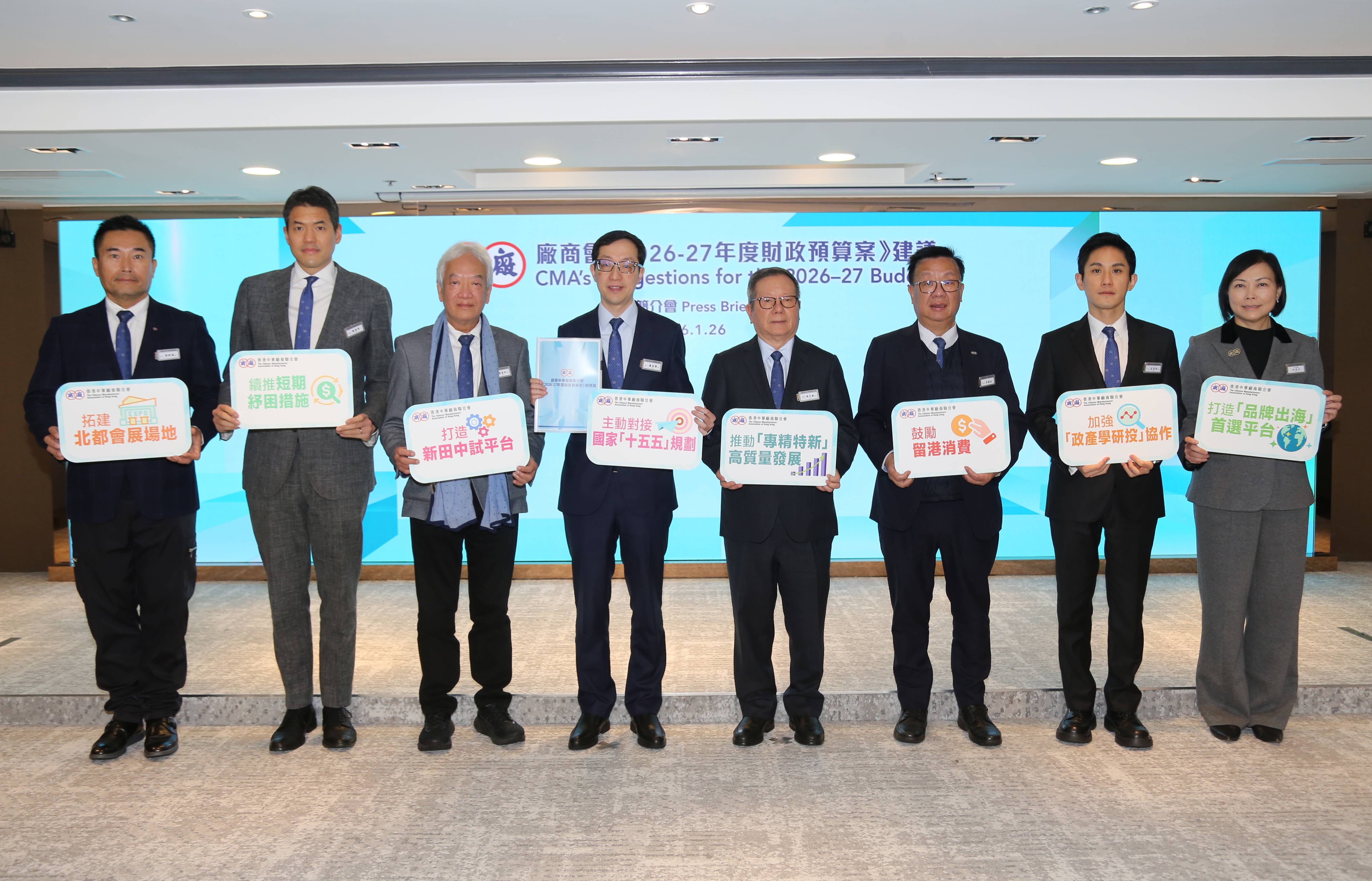
The CMA has submitted its policy recommendations for the 2026–27 Budget, offering more than 90 suggestions (from the left: Dr Ellis Wong, Mr Calvin Chan, Professor Simon Wong; Vice Presidents; Dr Wingco Lo, President; Dr Warren Ma, Executive Vice President; Mr Dennis Ng Kwok On, The Hon Albert Chuang, Vice Presidents; and Ms Ida Ng, Chief Executive Officer)
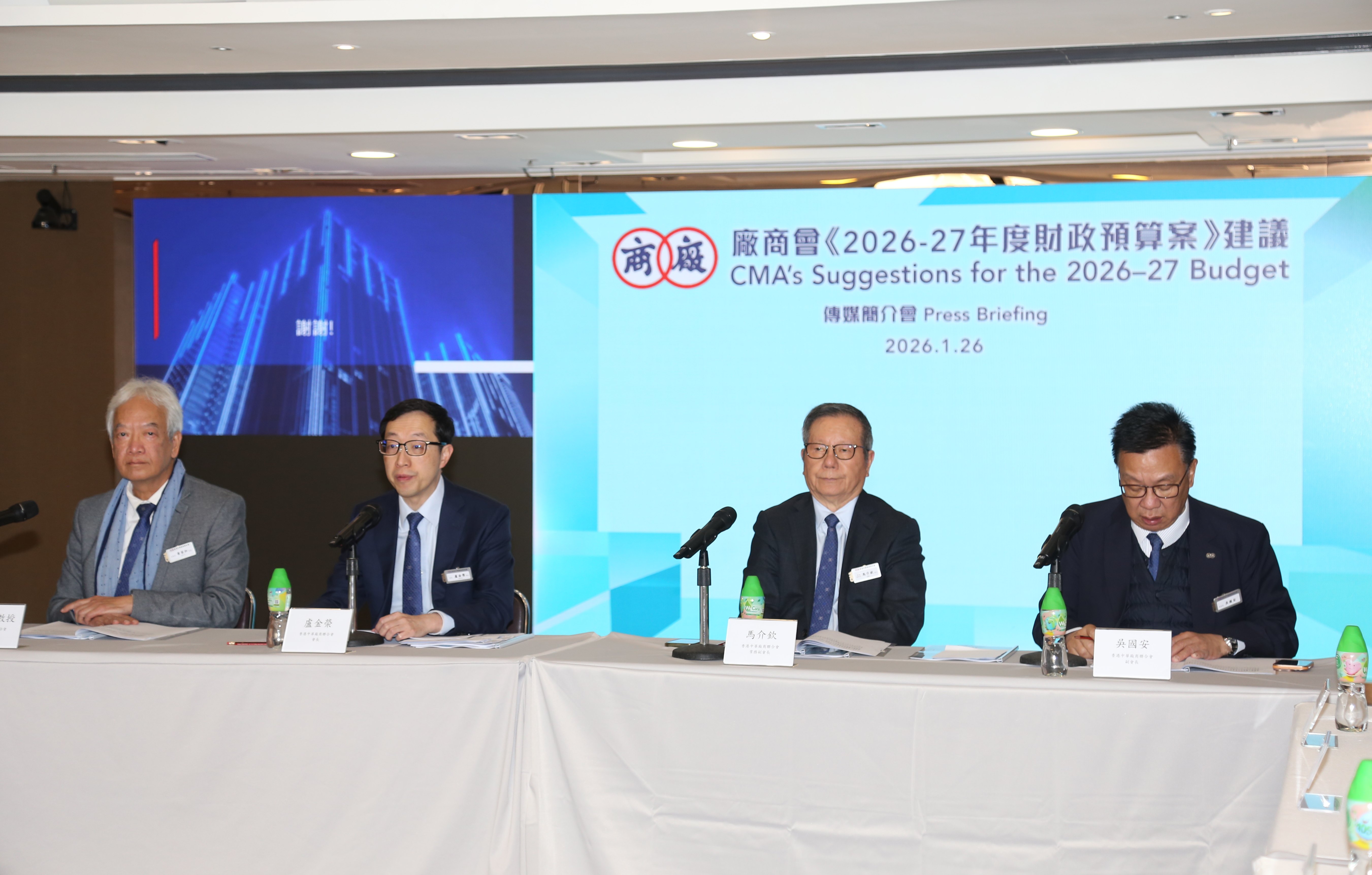
Dr Wingco Lo, President of the CMA (2nd from the left), calls on the government to take a more proactive role in boosting local consumption to sustain Hong Kong’s economic resilience
During a media briefing today (26 January), Dr Wingco Lo, President of the CMA, stated that while Hong Kong’s economy achieved steady recovery in 2025, the global outlook remains uncertain, with geopolitical risks potentially escalating. According to the association’s latest member survey, businesses generally maintain a cautious outlook for 2026. With export growth anticipated to moderate, domestic demand is expected to become the main driver of economic growth. Dr Lo calls on the government to take a more proactive role in boosting local consumption to sustain Hong Kong’s economic resilience.
Boosting domestic demand and fostering collaborative industrial growth
The CMA suggests that the government continue to roll out one-off relief measures and consider introducing incentives such as lucky draws to encourage local spending. The association also recommends favourable policies to create more diverse spending opportunities, including fostering the pet economy, rural homestays economy and hawker economy.
To support SMEs, the CMA calls for extending the application period of the 90% Guarantee Product under the SME Financing Guarantee Scheme to March 2028, in line with the 80% Guarantee Product. It also urges the government to review and improve the principal moratorium arrangement as needed.
In promoting I&T and new industrialisation, the CMA emphasises the importance of collaboration among government, industry, academia, research, and investment. It calls for enhancements to the Innovation and Technology Fund, enabling more independent applications by enterprises and incorporating economic indicators such as commercialisation potential, intellectual property value, and market prospects into the funding assessments. It also proposes further enhancing the mechanism of the Innovation and Technology Support Programme by exploring the introduction of a fast-track sub-programme specifically designed for collaborative projects that facilitate technology transfer and drive business upgrading.
To accelerate the translation of R&D into market-ready solutions, the CMA proposes the establishment of a technology and economic trading platform and service alliance led by universities and supported by strong industry participation.
In line with the global industrial shifts, the CMA advocates adopting a Gross National Income (GNI)-oriented approach to economic development, formally recognising outward industrial activities as part of Hong Kong’s manufacturing and new industrialisation ecosystem. To this end, the government should conduct a comprehensive survey of Hong Kong-funded manufacturing enterprises operating outside the city and develop a set of statistical indicators to track their development. The government should also set up a dedicated task force to better support this sector.
The CMA also reinforces the importance of supporting the high-quality development of “Specialised, Refined, Distinctive and Innovative” (SRDI) enterprises. It recommends the establishment of a Hong Kong-specific evaluation framework and recognition mechanism for SRDI enterprises, supported by tailored support policies. To provide a solid evidence base for policy formulation, the CMA has commissioned the HKUST Li & Fung Supply Chain Institute to carry out a dedicated study on this topic.
Accelerating the development of the Northern Metropolis
Regarding the future development of the Northern Metropolis, the CMA believes it is necessary to clearly define the functional positioning and collaborative relationships among various key zones, such as San Tin Technopole, the Loop, and Sha Ling, to avoid duplication and resource waste. The CMA also suggests partnering with renowned international or Mainland industrial park developers as strategic partners to accelerate development.
The CMA sees potential in expanding convention and exhibition facilities in the Northern Metropolis, aligned with the area’s industrial focus. It suggests prioritising expos in I&T, higher education, and emerging sectors such as new energy vehicles and low-altitude economy. In addition, integrating animation, film, cultural and creative industries, and eco-tourism could help create a demonstration zone for cultural-tourism integration.
Driving diversified economic growth
To strengthen Hong Kong’s position as a commodity trading hub, the CMA recommends introducing more spot and futures trading platforms for commodities such as coffee, soybeans, and non-ferrous metals. It also proposes utilising bonded warehouses in Mainland GBA cities to facilitate cross-border warehousing and delivery, and leveraging Hong Kong’s free port and logistics advantages to attract high-value, regulated goods for offshore storage and settlement.
The CMA welcomes the signing of a cooperation agreement between the Financial Services and the Treasury Bureau and the Shanghai Gold Exchange. To further enhance regional financial integration, the CMA recommends deepening collaboration with Mainland commodity exchanges to facilitate the cross-boundary listing of related financial products. At the same time, efforts should be made to develop RMB-denominated commodity benchmarks and settlement mechanisms. These initiatives would help mitigate exchange rate and price volatility, while contributing to the broader goal of RMB internationalisation.
In response to growing efforts by both Hong Kong and Mainland enterprises to expand into international markets, the CMA proposes establishing Hong Kong as a preferred platform for brands going global. It recommends fostering strategic alliances between local and national brands to leverage Hong Kong’s strengths and services. To support this vision, the CMA has consolidated its resources and will soon launch a one‑stop service to facilitate enterprises’ global expansion.
To inject new momentum into economic diversification, the CMA has also proposed initiatives such as promoting the silver economy, developing industrial tourism, expanding the halal market, establishing a regional intellectual property trading centre, and supporting enterprises in expanding into the Mainland domestic market.
As the country enters the 15th Five-Year Plan period, the CMA advocates for deeper cooperation between the government and the business sector to ensure close alignment with the latest national strategies. This collaboration should focus on formulating concrete, measurable action plans to advance Hong Kong as the “Eight Centres + Talent Hub”, while identifying new roles that leverage the city’s unique strengths.
Specifically, the CMA proposes positioning Hong Kong as an “International Brand Hub”, a “Going Global Launchpad”, and a “High-Value-Added International Supply Chain Management Centre”. It also encourages the government to seek formal recognition of these roles within the national development agenda. Such efforts will enable Hong Kong to more effectively contribute to and respond to the evolving needs of national development.
Other office-bearers of the CMA attending the media briefing included Dr Warren Ma, Executive Vice President; Professor Simon Wong, Mr Dennis Ng Kwok On, Mr Calvin Chan, The Hon Albert Chuang, and Dr Ellis Wong; Vice Presidents; and Ms Ida Ng, Chief Executive Officer.
Encls:
Summary of CMA budget recommendations
The CMA has submitted its policy recommendations for the 2026–27 Budget, offering more than 90 suggestions (from the left: Dr Ellis Wong, Mr Calvin Chan, Professor Simon Wong; Vice Presidents; Dr Wingco Lo, President; Dr Warren Ma, Executive Vice President; Mr Dennis Ng Kwok On, The Hon Albert Chuang, Vice Presidents; and Ms Ida Ng, Chief Executive Officer)
Dr Wingco Lo, President of the CMA (2nd from the left), calls on the government to take a more proactive role in boosting local consumption to sustain Hong Kong’s economic resilience